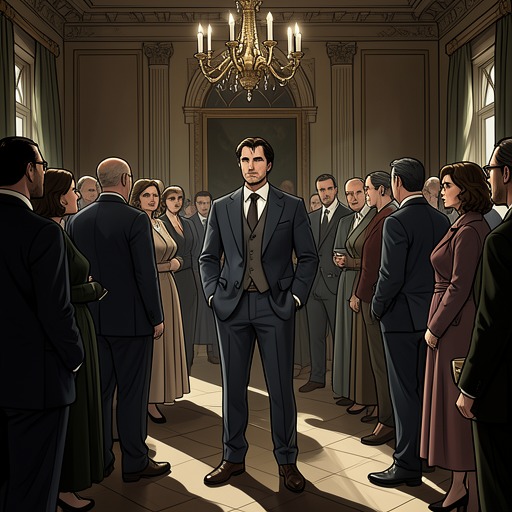
Martin Eden’s sudden fame as a bestselling author
Martin EdenMartin Eden’s sudden fame as a bestselling author is a reversal built on a distinction he cannot ignore: the world rewards him lavishly, yet he suspects that its admiration has little to do with the artistic power of his work. Publicity, sales, invitations, and elite recognition arrive together, making him a literary celebrity while exposing how uncertain the connection is between achievement and genuine understanding.
The Making of a Public Figure
At first Martin resists becoming a public personality. He has refused to give his publishers biographical information, but Oakland reporters seek out people who can supply it, and newspapers publish accounts of what he has and has not done—along with much that he has not done at all. Snapshots and photographs circulate; a local photographer who had once taken Martin’s picture copyrights it and puts it on the market. The publicity is not simply about his books. It turns his life and image into material for public consumption.
Martin initially fights this attention because of his disgust with magazines and bourgeois society. Yet resisting proves harder than yielding. He cannot bring himself to refuse the special writers who travel long distances to see him, and his days have become strangely open: he is no longer occupied with writing or study, and the hours still need filling. He permits interviews, discusses literature and philosophy, and accepts invitations from the very social world he had once opposed. Even the cub reporter who had painted him as a radical receives a full page and specially posed photographs. Martin forgives him, as he forgives everyone; publicity becomes less a victory he pursues than an intrusion to which he has ceased to object.
Bestseller Success and Its Uneven Foundations
The commercial breakthrough gathers force when the Meredith-Lowell Company rushes Overdue onto the market at the height of Martin’s popularity. As fiction, it sells even better than The Shame of the Sun. Week after week, Martin is credited with the unprecedented achievement of having two books at the top of the bestseller list. Readers of the earlier work are drawn to the sea story as well, impressed by the breadth of mastery with which he has handled it. The account of his success casts him as both critic and creator: he first attacks the literature of mysticism, then produces a work that successfully supplies the kind of literature he has analyzed.
The acclaim brings money as well as reputation. Martin flashes through the literary world like a comet, more amused than interested in the commotion around him. But the origin of that success troubles his confidence in it. The Shame of the Sun, rather than the stories rejected by magazines, has helped set off the landslide. Singletree, Darnley & Co. had printed only fifteen hundred copies and doubted they would sell; the publishers themselves are astonished by the book’s success and cannot explain it. Their letters convey reverent awe at the first unexpected event, not an account of a predictable market response.
Recognition as Social Currency
The celebrity produces an especially revealing change in Martin’s standing among people who previously dismissed him. Judge Blount invites him to dinner despite having insulted him and treated him badly. Martin remembers that, at earlier gatherings at the Morse home, the judge had not offered him such an invitation. Martin has not changed; what has changed is that his work now appears between book covers. He recognizes the invitation as a reward not for a new act or a newly acquired quality, but for an achievement already completed—work the judge had once sneered at while Martin was still writing and studying.
Martin accepts, grinning at his own composure. At the dinner, attended by half a dozen people in high places and their wives, he finds himself treated as the lion of the gathering. Judge Blount, strongly supported by Judge Hanwell, privately urges him to allow his name to be proposed for the Styx, an exclusive club for men of attainment as well as wealth. Martin declines. The invitation confirms how completely his public position has altered, while his refusal shows that admission to an elite circle is not the recognition he needs. The episode sharpens his suspicion that society has assigned a new value to the same person because the work is now visibly published and celebrated.
Fame, Understanding, and Disillusion
Martin doubts whether the popularity measures the value of his writing. The bourgeoisie buys his books and pours money into his hands, but he cannot see how a public he knows so little about could comprehend what he has written. He believes that his intrinsic beauty and power mean nothing to the hundreds of thousands acclaiming him. In his view, he is the fad of the hour: an adventurer who has stormed Parnassus while the gods were inattentive. The size of the audience does not reassure him; it makes the gap between sales and understanding seem larger.
Brissenden’s fate supplies the comparison that gives this doubt its force. Martin considers Brissenden’s Ephemera infinitely greater than anything he has written, yet the same crowd that now fawns on Martin had seized that poem and torn it apart. To Martin, the public’s response changes from fangs to flattery without becoming more perceptive; whether it attacks or celebrates is a matter of chance. Its applause therefore seems a poor tribute, particularly when the crowd that praises him failed to recognize what he regards as a poem of exceptional greatness.
At the height of his success, Martin is thus neither simply triumphant nor newly reconciled to the society that celebrates him. He has money, bestsellers, interviews, invitations, and the prospect of an elite club, but these outward proofs do not answer his question about artistic recognition. Instead, they reinforce his sense that public fame can attach itself to a person without understanding the work that supposedly warrants it. With his last manuscript sold, he is glad that he will soon be done with it all.